Disparities in NatureScore across U.S. public schools: implications for environmental and socioeconomic equity
Jan 1, 2025
A national analysis of 65,406 U.S. schools finds that nature access (measured by NatureScore™) is unequally distributed, with lower scores at schools serving more economically disadvantaged and minority students, pointing to the need for targeted green-infrastructure interventions.
Urban Forestry & Urban Greening
Abstract:
This study examines the impacts of NatureScore™ on educational equity by analyzing its correlation with racial demographics and socio-economic status (SES) across 65,406 United States schools.
While previous studies have examined nature access in educational contexts regionally, this study uniquely utilizes a comprehensive national dataset, evaluating NatureScore™ disparities across racial and socio-economic groups in urban and rural public schools.
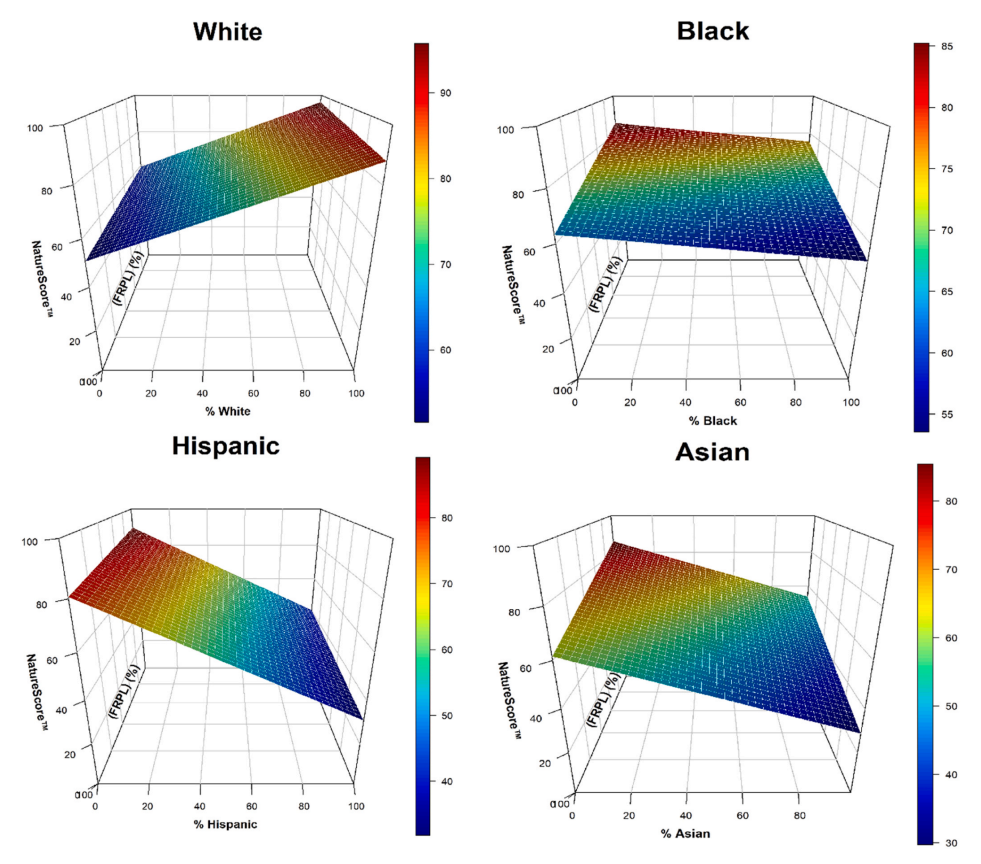
Using a cross-sectional design with data from 2022, the variability in NatureScore™ was analyzed concerning the percentages of students from different racial backgrounds and those participating in free or reduced-price lunch (FRPL) programs.
Multiple linear regression and bootstrap ANOVA were conducted to assess these relationships. Results show significant disparities: NatureScores™ are higher in schools with lower percentages of economically disadvantaged students and higher percentages of White students, indicating irregular distribution of nature across the U.S. Because NatureScore™ is calculated from 1-km buffers, our estimates reflect equity in the surrounding outdoor environment rather than indoor spaces or on-campus micro-features (like playgrounds, gardens).
In urban areas, the gap between low and high socio-economic status schools can reach up to 25 points on a 0 (deficit) to 100 (utopia) NatureScore™ scale.
Rural schools also show a consistent decline in NatureScore™ with increasing levels of economic disadvantage, although the differences are smaller (approximately 2.5–5 points) than those observed in urban schools.
These findings highlight the need for integrating environmental quality into educational and health equity frameworks, recommending targeted green-infrastructure and nature-based learning interventions in schools, particularly in schools serving economically disadvantaged and minority communities.

