EarthDefine Land Cover
High-resolution land cover for decisions on the ground
Seven ground-cover classes at 30cm or 60cm resolution, produced on demand for your area of interest across the United States.
EarthDefine Land Cover maps vegetation, water, bare ground, and built surfaces in detail. Our proprietary AI produces land-cover classifications with greater than 95% accuracy, typically delivered within days of an order. We can also classify older aerial imagery from our archive to create historical snapshots of your project area.
Use the data to assess tree canopy, understand impervious cover, support environmental analysis, and measure how land cover changes across years.
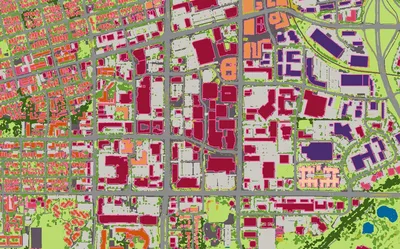
See the same area of Cape Coral, Florida, in aerial imagery and as classified land cover. The classification turns visible features into mapped classes you can measure, summarize, and combine with other data in your GIS.
Cape Coral, FL · NAIP imagery
EarthDefine Land Cover
The land-cover schema distinguishes vegetation, water, built surfaces, and bare ground, with a separate class for tree canopy over impervious surfaces.
A landscape often contains more than one kind of cover in the same place. Tree canopy can extend over a road, parking lot, or building. Identifying only the canopy can leave out information that matters to runoff, urban forestry, and infrastructure analysis.
EarthDefine uses an independent AI model for each ground-cover class, trained on high-resolution color-infrared imagery. This lets us identify overlapping features during classification and represent tree canopy over built surfaces in the land-cover output.
These purpose-built models also capture fine spatial detail: individual trees, small gaps and patches, narrow strips of bare ground, and small water bodies. Applied across large geographies, they produce consistent classifications that support both local analysis and broader summaries.
Coarse land-cover data helps describe broad patterns. Analyses of neighborhoods, development sites, and infrastructure corridors also need the smaller features within those patterns.
The National Land Cover Database (NLCD), produced by the U.S. Geological Survey, maps land cover across the contiguous United States at 30 meter resolution. It provides a useful view of broad land-cover patterns; local analysis often needs finer detail.
EarthDefine’s 30cm and 60cm classifications provide 50–100× finer spatial resolution, revealing individual trees, narrow streets, and small patches of ground cover that can disappear within a single NLCD pixel.
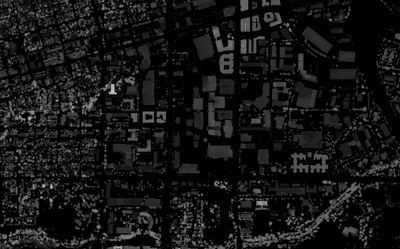
Compare the same area of Cape Coral, Florida, in NLCD’s 30 meter land cover and EarthDefine’s 30cm or 60cm classification. Look at the streets, tree canopy, and smaller patches of ground cover. These distinctions affect how you measure the distribution of vegetation and built surfaces across an area.
NLCD · 30 meter land cover
EarthDefine · 30cm land cover
You can order the full seven-class Land Cover dataset or individual classes for your area of interest. If your project needs impervious surfaces, tree cover, water, or another class, we can produce that layer independently.
Our purpose-built models classify each type of cover separately, so a focused delivery does not require producing the full land-cover dataset. Tell us which classes, geography, and imagery years you need, and we’ll help define the delivery.
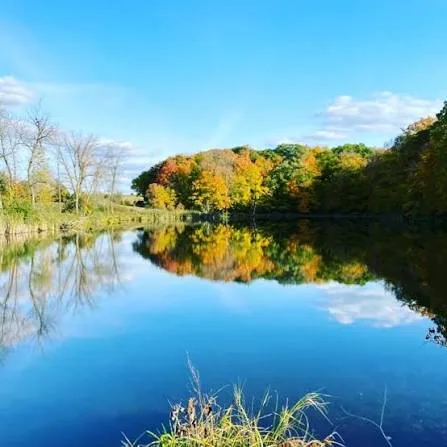
A dedicated water layer is one example of ordering individual land-cover classes. For projects focused on ponds, basins, streams, or lake margins, we can extract water independently. That's a smaller and faster job than producing the full seven-class classification.
At 30cm or 60cm resolution, a tenth-acre pond covers roughly a thousand pixels. That detail helps preserve the shape of small features: farm ponds, stormwater basins, narrow streams, and the margins of larger lakes. Small water bodies remain features you can examine and measure.
We have delivered statewide water layers for companies whose work depends on identifying ponds under an acre. Water-only deliveries are available as polygons in an Esri File Geodatabase or shapefile, covering a county, a state, or a custom area of interest.
EarthDefine’s water classification supports questions about surface area at the imagery date and comparisons across historical imagery. Tell us the geography, feature sizes, and years that matter to your project, and we’ll help define the delivery.
Pictured: Gaston pond, a 15 square-acre (0.1 sqkm) natural waterbody in Barre, Massachusetts.
Land Cover supports agencies, companies, and nonprofits working across planning, infrastructure, and environmental analysis.
Urban forestry and community planning. Measure current tree canopy and assess potential canopy as part of an Urban Tree Canopy assessment. Monitor urban growth and use land-cover information to improve population surface maps through dasymetric mapping for disaster-risk analysis.
Stormwater, watersheds, and erosion. Analyze the distribution of impervious surfaces and other land-cover types to support estimates of runoff quantity and quality. Combine land cover with terrain data to investigate erosion risk.
Environmental assessment and land-cover change. Support environmental impact assessments for construction projects, habitat studies, and monitoring of land-cover change associated with oil and gas development. Model carbon storage and changes associated with different land-cover types.
Infrastructure and wireless planning. Use land-cover information in least-cost pathway analysis for utility corridors and highways. Derivative clutter classifications support radio-wave propagation modeling for wireless planning.
Wildfire and ecological assessment. Use vegetation and other land-cover classes as inputs to wildfire-risk modeling and post-fire ecological impact studies.
Land Cover is produced on demand from the latest available imagery from the USDA National Agriculture Imagery Program (NAIP), a long-running aerial imagery program that acquires approximately half of the contiguous United States each year. This recurring coverage provides a consistent source of high-resolution imagery for current mapping and repeat analysis over time.
Historical snapshots are also available from our imagery archive, allowing the same land-cover schema to be applied to earlier years.
When planning a delivery, tell us:
We’ll help you evaluate available imagery and define the delivery for your workflow.
Browse free samples from Colorado, Florida, Oregon, and Washington. Open a sample in your GIS, compare the classification with aerial imagery, and inspect the features that matter to your analysis.
The samples let you examine the class distinctions and spatial detail before choosing a delivery for your project.
The standard classification includes herbaceous vegetation, bare surfaces, impervious surfaces, water, trees, shrubs, and trees over impervious surfaces.
Land Cover is produced at 30cm or 60cm resolution, with greater than 95% accuracy. Download a sample to examine the classification detail in your own workflow.
Yes. You can order any of the seven land-cover classes individually or select the combination your project needs. Each class is mapped independently, so you don’t need to order the full dataset to get water, impervious surfaces, tree cover, or another class. Tell us your area of interest and which classes you need, and we’ll help define the delivery.
Land Cover can be produced for areas of interest across the United States.
Deliveries use the latest available NAIP imagery for the requested geography. The conditions represented in the classification correspond to the source imagery’s acquisition date.
Yes. We can classify older imagery from our archive to create historical snapshots. Contact us to discuss imagery availability for your area and years of interest.
Yes. Water is classified independently and can be delivered as a dedicated polygon layer in an Esri File Geodatabase or shapefile.
Land Cover is typically delivered within days of an order. Contact us with your area of interest and requirements to discuss timing.
Yes. Browse the free Land Cover samples and inspect the data in your own GIS tools.
Tell us where you work, what you need to analyze, and which years matter. We’ll help you evaluate coverage and define a Land Cover or surface-water delivery for your project.